Since 1953, Lincoln has relied on Bill’s for Fast, Local, and Reliable Furnace Repair.
A lot of the no-heat calls we get the first cold week of the year turn out to be small. A flame sensor with a film on it. A filter nobody has touched since April. Some turn out not to be small at all, and you won’t know which kind you have until someone looks.
When your furnace quits, you call our office on Garfield Street and talk to a person who can see where our trucks are. Most furnace repairs in Lincoln get done the same day. We answer around the clock at (402) 477-1371.
If you smell gas or your CO alarm is going off
Leave the house first. Don’t flip switches or try to relight the furnace on your way out. Call 911 or your gas company from outside, then call us.
We mean that order. We’d much rather find you in the driveway in your coat than inside waiting for us. Here’s more on carbon monoxide warning signs.
What we repair
Gas furnaces are most of what we see in Lincoln, but we also work on electric furnaces, heat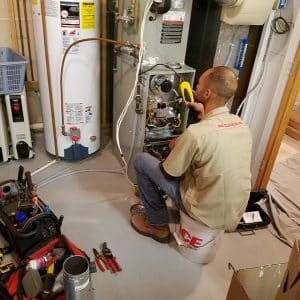 pumps, and dual-fuel systems that pair the two. Brand doesn’t matter much. We install American Standard, and our techs service Trane, Carrier, Lennox, Rheem, Bryant, Goodman, York, and Amana every winter.
Trucks go out stocked with the parts that fail most often, so the majority of repairs finish in one visit. Not all of them. Sometimes a part has to come from Omaha, and when that happens you’ll hear it on the first visit, along with when we expect it.
Signs it’s time to call
Cold air from the vents. The burners either aren’t lighting or aren’t staying lit. On a newer furnace, that’s usually the igniter or a dirty flame sensor; on an older one, the pilot. Before you call, check that the thermostat is set to heat and has working batteries, and pull the filter. We’re glad to come out either way, but nobody enjoys paying for a service call that turned out to be a filter.
Starting and stopping every few minutes. Short cycling leaves the far rooms cold and wears out parts fast. Restricted airflow can overheat the furnace and trip a safety switch, and a flame sensor that can’t read the flame will shut the burners off. Sometimes the furnace is simply too big for the house. No part fixes that, and we’ll tell you so rather than sell you a repair.
A bang when it lights. That’s delayed ignition: gas builds up for a second before it catches. Don’t wait on this one. Squealing points to the blower motor, and grinding usually means a bearing is going.
A yellow or orange flame. Burner flames should be mostly blue. A lazy yellow flame means the gas isn’t burning cleanly, which is how carbon monoxide forms. Turn the furnace off and call.
Snow around the white pipes on the side of the house. This one is a Lincoln winter special. High-efficiency furnaces vent through PVC pipes, and after a heavy snow or a drift off a north wind, those pipes get buried or frosted shut. The furnace shuts itself down to stay safe. Gently clear the snow and give it a few minutes; it often restarts. If it doesn’t, call us.
A gas bill that keeps climbing while your habits haven’t changed is the quiet version of all this. It’s worth a look before it turns into a no-heat call in January.
What a repair visit looks like
The tech looks at the whole system, not only the part making noise, because a failed igniter is sometimes a symptom of something else. Then they explain what’s wrong and hand you a written price. Nothing gets repaired until you say yes.
After the repair, we run the furnace through a full heating cycle and test for carbon monoxide before we pack up. A typical Furnace Repair, including the service fee, is usually between $500 and $900.
Repair it or replace it?
We’ll fix an old furnace if fixing it makes sense, and we’ll say so when it doesn’t. Our rough rule: once a furnace is past fifteen years, or a repair costs close to half the price of a new system, replacement usually comes out ahead. A cracked heat exchanger on an older furnace almost always ends the conversation, because that crack is how combustion gases get into the air you breathe.
If you’re on the fence, read whether your furnace is worth repairing. If it’s time for a new one, here’s how we size and install furnaces in Lincoln.
Furnaces in Lincoln houses
Lincoln’s housing stock changes the job. Houses in Near South and around the Country Club neighborhood often have furnaces fitted into basements built decades before modern equipment, feeding original duct runs that were never sized for today’s blowers. The 1990s houses in Fallbrook bring a different set of problems, and a lot of their original furnaces are near the end of the road now. Our techs see both every week, which is most of why diagnosis goes quickly.
We cover Lincoln and the rest of Lancaster County, including Waverly, Hickman, Bennet, Malcolm and Raymond. Not sure you’re in range? Call and ask.
Keep the next breakdown from happening
Many of our October and November calls come from furnaces that sat untouched all summer and then got asked to run hard on the first cold night. A fall tune-up catches the cheap problems first: the flame sensor gets cleaned, the burners checked, the filter swapped, and the whole system tested for carbon monoxide. Our furnace and AC maintenance plan covers a fall furnace visit and a spring AC visit, and members get scheduled first when half the city’s furnaces quit the same week.
Questions people ask
How fast can you get here? Most furnace repairs happen the same day. For no-heat emergencies, we typically arrive within two to four hours, day or night.
How much does furnace repair cost? It depends on the part. You’ll get a written price before any work starts, and you won’t pay for anything you didn’t approve. An average furnace repair, including the service fee is usually between $500 and $900.
Why is my furnace blowing cold air? Usually the burners aren’t lighting or staying lit, often from a failed igniter or a dirty flame sensor. Check the thermostat setting and the filter first, then call.
Do you work on furnaces you didn’t install? Yes. We service Trane, Carrier, Lennox, Rheem, Bryant, Goodman, York, Amana, and American Standard.
Do you serve towns outside Lincoln? Yes. We cover Lancaster County, including Waverly, Hickman, Bennet, Malcolm, and Raymond.
Should I repair or replace my furnace? If it’s over fifteen years old, or the repair costs close to half the price of a new system, replacement usually makes more sense. We’ll give you a straight answer based on your furnace.
Call Bill’s
Bill’s has kept Lincoln houses warm since 1952, and the family that started it still runs it. Call (402) 477-1371 any time, or request furnace service online.